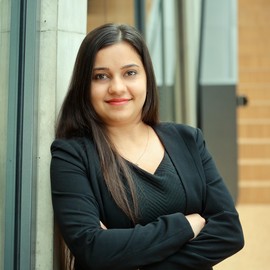
Biography

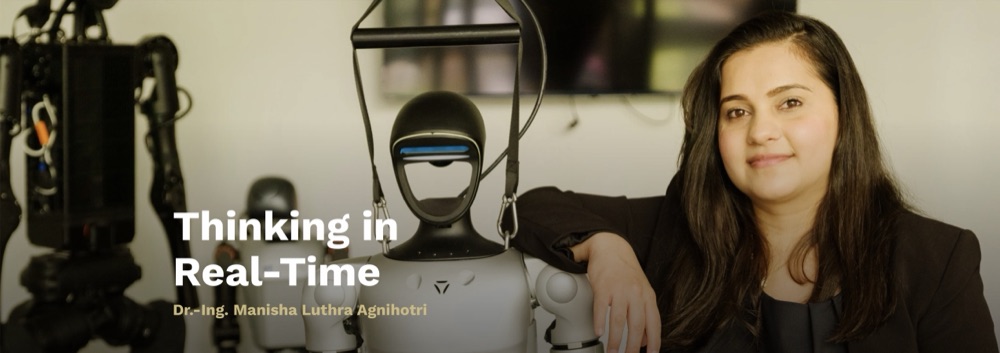
I am a researcher working at the intersection of real-time data systems, machine learning, and intelligent data processing. My goal is to build the next generation of data systems that not only process continuous streams of data with high performance but also learn, adapt, and understand rich, multimodal inputs such as text, images, audio, and sensor signals all at real-time. Starting April 2026, I joined Ruhr-Universität Bochum as a Junior Professor of Databases and Information Systems, where I will establish a research group on next-generation data systems that combine classical data system principles with modern AI techniques.

I am also a Junior Research Group Lead as Athene Young Investigator at the Systems Group of TU Darmstadt. Before that, I was a deputy head leading the SAIDE Lab of German Research Centre for Artificial Intelligence (DFKI) Darmstadt together with Prof. Carsten Binnig.

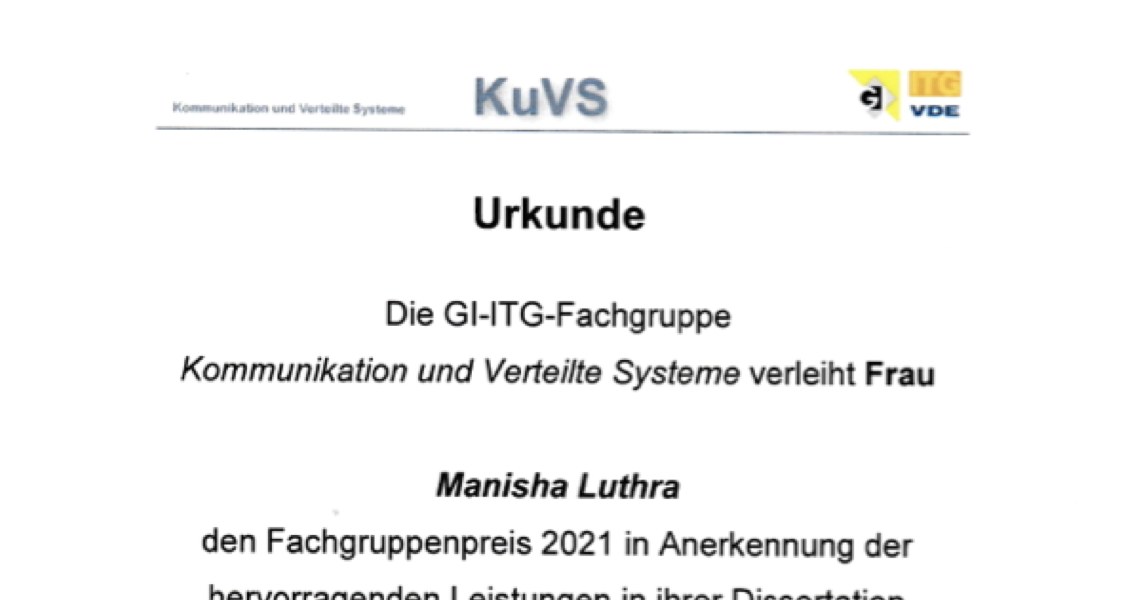
In 2021, I completed my doctoral degree (officially, Dr.-Ing. or Doctor of Engineering) from TU Darmstadt with a thesis on Network-centric Complex Event Processing that was graded with summa cum laude. My thesis received the German national award for the Best Ph.D. thesis in the field of distributed systems by the special interest group on Communication and Distributed Systems (KuVS).

Currently in my research, I broadly focus on the intersection of systems and machine learning while at the same time leverage modern hardware and networks to their best.
Interests

  • Machine Learning and Systems
  • Multimodal Data Processing
  • Modern Hardware and Networks

Education

  • Ph.D. (Dr.-Ing.) with the topic titled "Network-centric Complex Event Processing", 2016-2021

    Technical University of Darmstadt, Germany

  • M.Sc. Computer Science with specialization in Distributed Systems, 2013-2016

    Technical University of Darmstadt, Germany

  • B.Sc. with Honours in Computer Science, 2008-2011

    Delhi University, India

Selected Publications

This is a selected list of publications. To view all my publications click here.

(2025). Towards a Multimodal Stream Processing System. EDBT 2026.

PDF

(2025). Learned Cost Models for Query Optimization: From Batch to Streaming Systems. Proc. VLDB Endow. 18(12), 2025.

PDF DOI

(2025). Opening The Black-Box: Explaining Learned Cost Models For Databases. Proc. VLDB Endow. 18(12), 2025.

PDF DOI

(2025). How Good are Learned Cost Models, Really? Insights from Query Optimization Tasks. Proc. ACM Manag. Data (SIGMOD 2025).

PDF DOI

(2025). Dema: Efficient Decentralized Aggregation for Non-Decomposable Quantile Functions. EDBT 2025.

PDF

(2024). PDSP-Bench: A Benchmarking System for Parallel and Distributed Stream Processing. TPCTC 2024.

PDF DOI

(2024). COSTREAM: Learned Cost Models for Operator Placement in Edge-Cloud Environments. IEEE ICDE 2024.

PDF

(2024). ZERoTuNE: Learned Zero-Shot Cost Models for Parallelism Tuning in Stream Processing. IEEE ICDE 2024.

PDF DOI

(2023). No One Size (PPM) Fits All: Towards Privacy in Stream Processing Systems. ACM DEBS 2023.

PDF DOI

(2023). Distributed GPU Joins on Fast RDMA-capable Networks. To appear in ACM SIGMOD 2023.

(2023). Zero-Shot Cost Models for Parallel Stream Processing. aiDM@SIGMOD 2023.

PDF DOI

(2023). A Tutorial Workshop on ML for Systems and Systems for ML. BTW 2023.

(2022). FA2: Fast, Accurate Autoscaling for Serving Deep Learning Inference with SLA Guarantees. IEEE RTAS 2022.

PDF DOI

(2022). PANDA: Performance Prediction for Parallel and Dynamic Stream Processing. ACM DEBS 2022.

PDF DOI

(2022). The Case for Multi-Task Zero-Shot Learning for Databases. AIDB workshop in VLDB 2022.

PDF

(2022). Zero-shot cost models for Distributed Stream Processing. ACM DEBS 2022.

PDF DOI

(2021). TCEP: Transitions in operator placement to adapt to dynamic network environments. Journal of Computer and System Sciences.

PDF Code DOI

(2020). Operator as a Service: Stateful Serverless Complex Event Processing. IEEE BigData 2020.

PDF Code DOI

(2019). INetCEP: In-Network Complex Event Processing for Information-Centric Networking. IEEE ANCS.

PDF Code DOI